Sens Cathedral : the Origins of Gothic Architecture
At the heart of Sens’s historic centre, a remarkable ensemble tells nearly a thousand years of European history. Surrounding Saint Stephen’s Cathedral are the Synodal Palace, the Archiepiscopal Palace and the cathedral’s remarkable Treasury.
This ensemble highlights the exceptional role played by Sens in the Middle Ages, when the city was one of the great religious and political capitals of the Western world. Today, it represents a rare heritage site where architecture, history, art and major European exchanges converge.
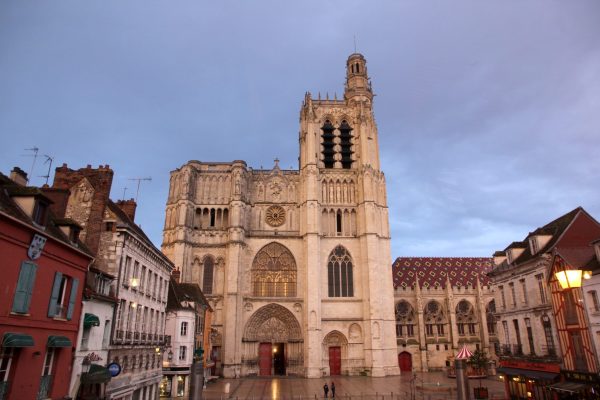
Built from 1130–1135 onwards, Saint Stephen’s Cathedral belongs to the very first generation of great Gothic buildings.
Its importance lies not only in its age, it is a testement to a decisive moment when medieval builders were experimenting with a new way of designing the space, light and structure of a cathedral.
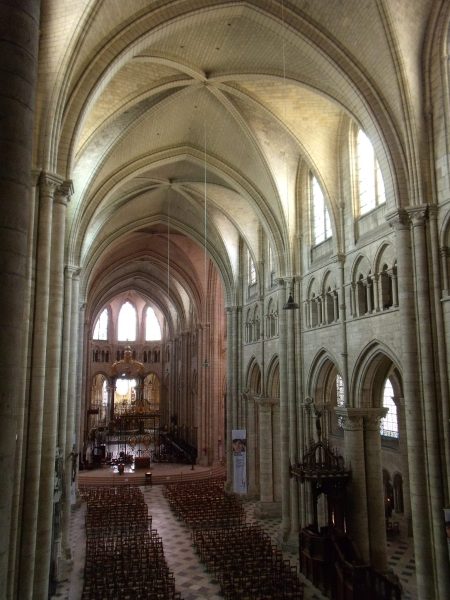
In Sens, several features that would become hallmarks of Gothic architecture appeared at an early stage:
- sexpartite rib vaults spanning a nave of exceptional breadth for its time;
- a three-level elevation, with great arcades, a triforium and clerestory windows;
- an original alternation between strong piers and lighter supports;
- a particularly unified spatial design, encouraging continuity between the nave and the choir.
Sens Cathedral does not represent Gothic architecture in its fully developed form. Rather, it allows us to understand how this new architectural language gradually took shape. This is what gives it a distinctive place among the great French cathedrals.
Did you know?
The building project at Sens is directly linked to the spread of new Gothic expertise across Europe. In 1174, the architect Guillame of Sens was called to England to take part in the reconstruction of the choir of Canterbury Cathedral following a fire.
Sens thus became a major part of the circulation of architects, techniques and ideas between France and England.
For centuries, Sens was the seat of a powerful ecclesiastical metropolitan authority, to which the Diocese of Paris belonged until 1622. The district therefore brought together the principal centres of religious, administrative and judicial power.
The Synodal Palace
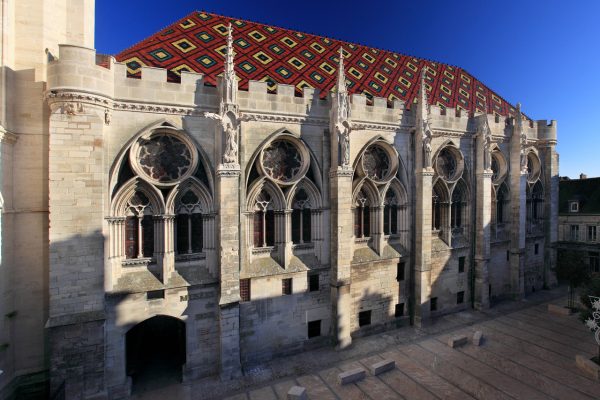
Built between 1230 and 1240, the Synodal Palace is one of the great examples of 13th-century Gothic civil architecture.
It housed the Officiality, the metropolitan ecclesiastical court. This court could hear appeals from several dioceses, including Paris, Chartres, Auxerre, Meaux, Orléans, Nevers and Troyes.
Upstairs, the Great Synodal Hall, a vast space of around 500 m², hosted councils and assemblies.
One of the palace’s most striking features lies underground, the episcopal prisons with former cells, ironwork and hundreds of inscriptions and drawings engraved by prisoners between the 13th and 17th centuries.
The Archiepiscopal Palace: several centuries of architecture
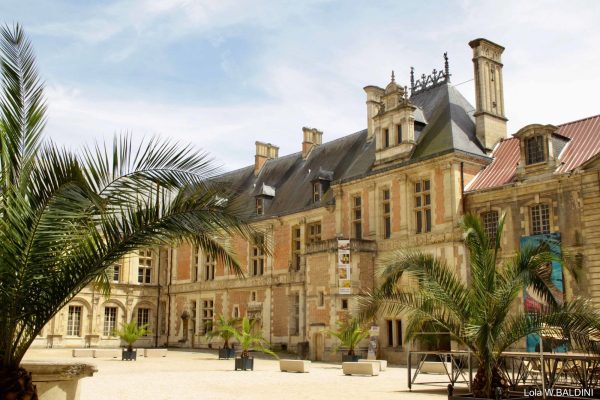
Connected to the Synodal Palace, the Archiepiscopal Palace reflects several periods in architectural history, from the French Renaissance to the Classical period. The Renaissance wings, courtyards, gardens, Orangery and Great Stables form an ensemble that allows visitors to trace the evolution of the site over several centuries.
The palace is also closely connected to the history of the Treasury of Sens, which is now displayed within this archiepiscopal complex.
The Treasury of Sens: a journey through Europe and the East
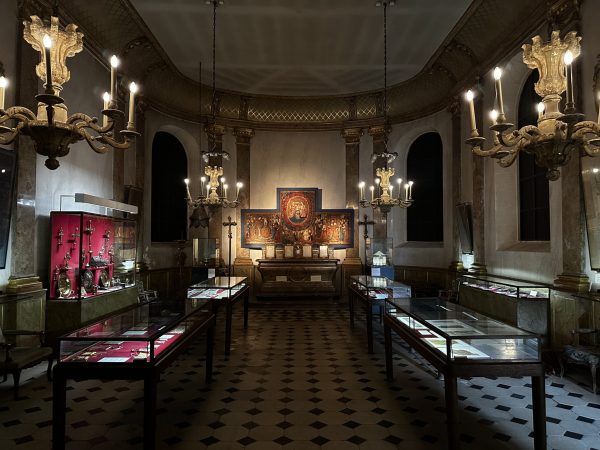
Preserved within the historic archiepiscopal complex, the Treasury brings together objects and textiles accumulated over centuries. Its richness reflects the exchanges that connected the East, the Mediterranean world and the Christian West.
Among the treasures on display are:
- Byzantine, Persian, Coptic and Islamic silks, witnesses to exchanges along the trade routes of the East;
- exceptional medieval textiles, including the shrouds of Saint Loup and Saint Siviard;
- pieces of goldsmithery and ivory;
- the Holy Casket and other remarkable liturgical objects;
- relics connected with the history of Western Christianity;
- remarkable liturgical vestments of Saint Thomas Becket.
Thomas Becket: an exceptional link between Sens and Canterbury
The history of Sens is intimately connected with that of Thomas Becket, Archbishop of Canterbury.
In conflict with the King of England, Henry II, Becket stayed in Sens during his exile in the 12th century. His presence can still be felt today in the cathedral and, above all, in the Treasury, which preserves several of his liturgical garments.
This connection gives the Cathedral District a very tangible European dimension: at Sens, the histories of France, England and the medieval Church meet.
In the footsteps of the great figures of history
The Cathedral District has been the setting for events that reach far beyond local history.
Primate of Gaul and Germania
In 875, Sens Archbishop Ansegis was appointed Primate of Gaul and Germania by Emperor Charles the Bald, a direct descendant of Charlemagne. This title is still held today by the Archbishops of Sens.
The Council of Sens
In 1140, Sens was also the setting for the famous intellectual confrontation between Peter Abelard and Bernard of Clairvaux.
The Council of Sens was a major episode in the history of medieval thought and bears witness to the city’s role as a centre of theological and intellectual debate.
Pope Alexander III in Sens
Between 1163 and 1165, Pope Alexander III and his curia took refuge in Sens. During this period, the city temporarily became a major centre of Western Christianity. The dossier also highlights the consecration in Sens of Stephen, the first Archbishop of Uppsala, marking an important episode in the history of the Church of Sweden.
The marriage of Saint Louis
On 27 May 1234, King Louis IX, later known as Saint Louis, married Margaret of Provence in Sens Cathedral.
A few years later, in 1239, the city once again played a role in the history of the Passion relics when the Crown of Thorns, acquired by Saint Louis, was solemnly welcomed there. Thorns preserved in the Treasury are still associated with an annual pilgrimage.
A heritage site and a journey through time
One of the great strengths of the Cathedral District is that, within a relatively compact area, visitors can explore different periods and different dimensions of history.
From the 12th-century Gothic cathedral to the 13th-century Synodal Palace, from the Renaissance buildings of the Archiepiscopal Palace to its Classical additions, from the canons’ cloister to the Treasury and its objects that sometimes travelled from far away, each monument contributes a different piece to the story of Sens.
The district itself is part of the city’s ancient history. It occupies part of the historic centre corresponding to the former Gallo-Roman city of Agedincum, whose urban layout profoundly influenced the development of Sens.
An iconic landmark in the Sens landscape
With its south tower rising to approximately 78 metres, Saint Stephen’s Cathedral is a major landmark in the cityscape of Sens.
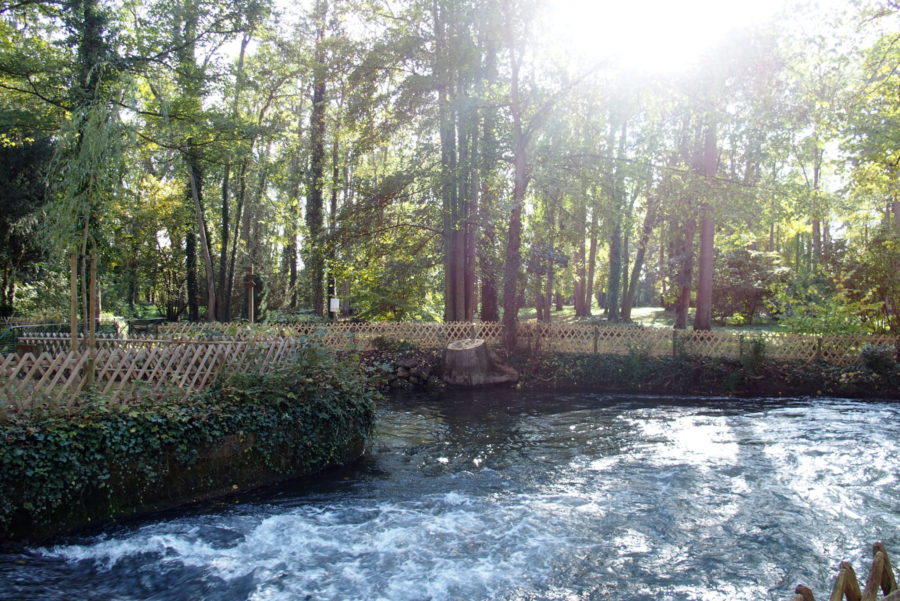
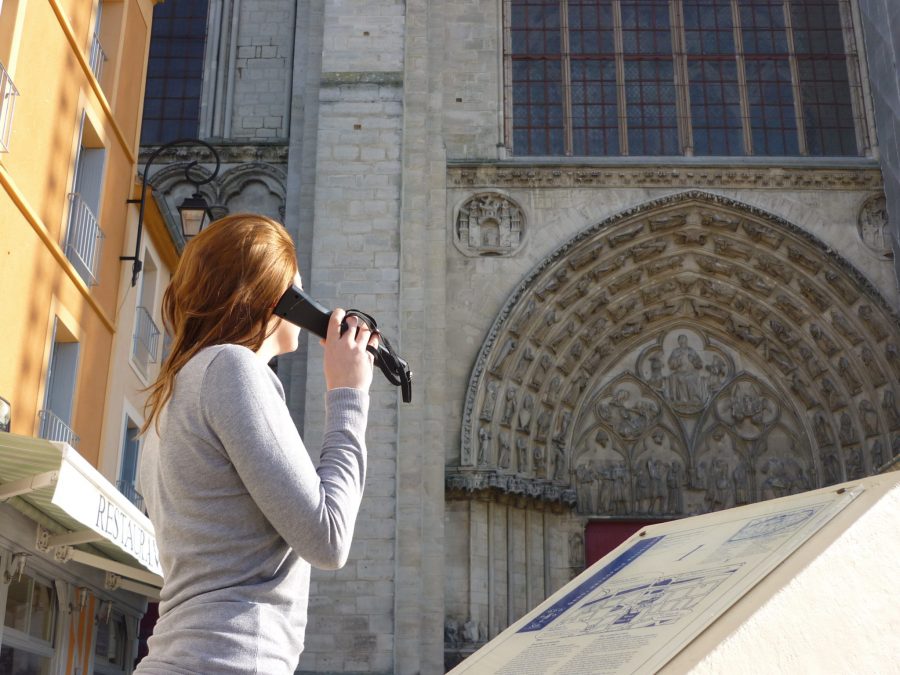
From the old streets, different perspectives gradually reveal its portals and western façade. From the palace grounds and gardens, other viewpoints reveal the monument from a different angle.
This relationship between the monuments and the city is essential: here, heritage is not an isolated backdrop. It forms a genuine historic district that remains visible within the contemporary urban fabric.
Why is the Sens Cathedral District exceptional?
In Sens, visitors do not come simply to admire a cathedral. They come to understand a formative moment in the history of European architecture, follow in the footsteps of great historical figures, discover a former centre of power and travel, through the Treasury’s collections, from the medieval East to the kingdoms of the West.
It is this combination of architecture, history, remarkable figures, religious heritage, precious arts and European exchanges that gives the Cathedral District its unique character.
Top attractions :
Saint Stephen’s Cathedral
To observe the pioneering features of early Gothic architecture and understand the development of medieval architecture.
The façade and sculpted portals
The restoration completed in 2025 has helped reveal the richness of the sculpture, including traces of medieval polychromy.
The Synodal Palace
To discover Gothic civil architecture, the Great Hall and the history of ecclesiastical justice.
The former prison cells
A particularly unusual place where graffiti left by prisoners recounts several centuries of history.
The Archiepiscopal Palace
To explore a true architectural stratigraphy, from the Renaissance to the Classical period. The building now houses the collections of the Sens Museum.
The Cathedral Treasury
To admire precious textiles, ivories, goldsmithery and relics, including the vestments associated with Thomas Becket.
Sens, a city at the heart of European history
The Cathedral District ultimately reminds us that Sens was far from being a secondary city in the Middle Ages. For centuries, it was a leading religious, political, judicial, artistic and intellectual centre.
Today, its heritage preserves tangible traces of this history: a pioneering Gothic cathedral, a medieval judicial palace, an archiepiscopal residence, the remains of a former cloister and an exceptional Treasury.
An invitation to discover Sens: look up towards the vaults, step through the doors of the former palaces and follow the thread of a history that connects the city to the great centres of medieval Europe.
Guided tours
- With a guide: classic tours, evening tours, theme tours or a climb to the South Tower (in June, July and August ) booking required through the Sens Intense Tourist Office).
- Visitor leaflet (available for purchase from the Tourist Office)
- Interactive tour for children (free app to download, or tablet rental from the Tourist Office).
- Audio guide
Opening hours: 7:00 am – 7:00 pm (free access, except during religious services).